We Use CookiesWe use cookies to enhance the security, performance, functionality and for analytical and promotional activities. By continuing to browse this site you are agreeing to our privacy policy

10 Best Benchtop Wood Planers 2026 in the United States
How do we rank products for you?

Our technology thoroughly searches through the online shopping world, reviewing hundreds of sites. We then process and analyze this information, updating in real-time to bring you the latest top-rated products. This way, you always get the best and most current options available.

headphones-stars

Our Top Picks

#1

Winner

WEN Thickness Planer, Two Speed, 13-Inch Spiral Blade, Benchtop (PL1337)

Rating
10.0
Chosen by1,215
Cutting Width
Cutterhead Type
Dust Collection

Most important from
80 reviews

Cutting Width
The planer’s width of 13 inches is sufficient for most home projects and balances capacity with affordability.
Cutterhead Type
The spiral cutterhead with HSS blades effectively minimizes tear-out and produces an excellent surface on both sides of the board.
Dust Collection
Dust collection works best when connected to a dedicated dust collector rather than a standard shop vac, keeping the workspace much cleaner.
Portability
Weighing around 69 to 80 pounds, it offers solid stability but is best suited for a dedicated workshop space rather than portability.

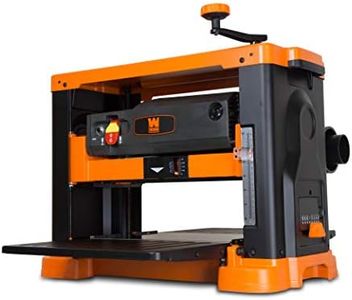
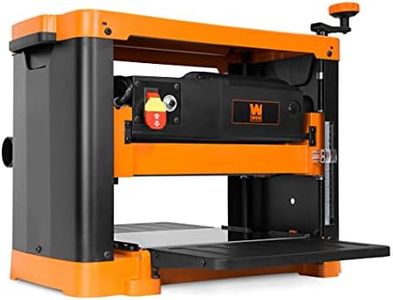
The WEN PL1337 is a solid benchtop wood planer that suits hobbyists and small workshop users who need to dimension boards efficiently. It handles boards up to 13 inches wide and 6 inches thick, which is generous for most home woodworking projects. Its 15-amp motor runs the spiral cutterhead at 10,000 RPM, producing a smooth finish with 26 HSS blades that are staggered and rotatable. This spiral cutterhead design helps reduce tear-out, making it easier to get clean results. A standout feature is the two-speed feed rate: 26 feet per minute for faster stock removal and 16 feet per minute when you want a finer finish.

The maximum cutting depth per pass is 0.13 inches, typical for this class of planer, allowing for controlled material removal. Dust collection is versatile with a combo 2.5-inch and 4-inch port, which helps keep your workspace cleaner when connected to a vacuum or dust collection system. Weighing 69 pounds, it’s stable but not very portable, so it’s best suited for a dedicated workshop space. Some users might find it a bit bulky if space is tight.

It comes with useful extras like a depth stop, onboard material removal gauge, wrench storage, and return rollers to help feed boards smoothly. The two-year warranty adds confidence in the product’s durability. Although not the lightest or smallest model, the WEN PL1337 strikes a strong balance of power, precision, and finish quality among benchtop planers in its price range.

Rating
10.0
Chosen by1,215
Cutting Width
Cutterhead Type
Dust Collection

Most important from
80 reviews

Cutting Width
The planer’s width of 13 inches is sufficient for most home projects and balances capacity with affordability.
Cutterhead Type
The spiral cutterhead with HSS blades effectively minimizes tear-out and produces an excellent surface on both sides of the board.
Dust Collection
Dust collection works best when connected to a dedicated dust collector rather than a standard shop vac, keeping the workspace much cleaner.
Portability
Weighing around 69 to 80 pounds, it offers solid stability but is best suited for a dedicated workshop space rather than portability.
#2

Makita KP312 12-1/4" Planer

Rating
9.1
Motor Power
Cutterhead Type
Portability

Most important from
28 reviews

Motor Power
The powerful 15 AMP motor delivers strong cutting performance, making it a reliable tool for heavy-duty timber framing and hardwood work.
Cutterhead Type
Upgrading to carbide Shelix blades transforms the planer with faster wood removal, quieter operation, and longer-lasting blades that outperform standard ones by tenfold.
Portability
Despite its weight, the planer offers excellent value compared to pricier competitors, combining robust power with solid build quality.

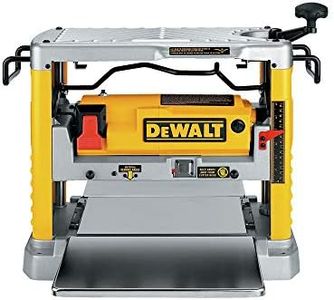
The Makita KP312 is a solid benchtop wood planer well-suited for hobbyists and small woodworking shops. It offers a 12-1/4 inch cutting width, which is fairly generous for handling medium-sized boards. The powerful 15 AMP motor spinning at 12,000 RPM gives it strong cutting performance, making it capable of handling tougher hardwoods efficiently. The durable cast iron base adds stability during use, which helps with precision.

One of its user-friendly features is the large depth setting knob, allowing easy and accurate adjustments for cutting depth. The poly 'V' belt system efficiently transfers power to the blades, contributing to smooth operation. The large ejection chute is designed to manage wood chips well and helps prevent clogs, which is useful when working with different wood types or moisture levels. Additionally, the front roller aids in moving the planer over rough materials, enhancing portability despite the machine's 40.6-pound weight.

The planer’s weight means it’s not the most portable option if you need to move it frequently or on job sites. Dust collection depends largely on the ejection chute design, so pairing it with an external dust system might be necessary for cleaner workspaces. The Makita KP312 provides strong motor power, good cutting width, and convenient controls, making it a dependable choice for woodworking enthusiasts who want reliable performance in a benchtop planer. Those needing a lightweight or highly portable unit might find it a bit heavy, but its stability and power compensate well for stationary use.

Rating
9.1
Motor Power
Cutterhead Type
Portability

Most important from
28 reviews

Motor Power
The powerful 15 AMP motor delivers strong cutting performance, making it a reliable tool for heavy-duty timber framing and hardwood work.
Cutterhead Type
Upgrading to carbide Shelix blades transforms the planer with faster wood removal, quieter operation, and longer-lasting blades that outperform standard ones by tenfold.
Portability
Despite its weight, the planer offers excellent value compared to pricier competitors, combining robust power with solid build quality.
#3

WEN PL1326 15-Amp 13-Inch Spiral Benchtop Thickness Planer

Rating
8.5
Cutting Width
Motor Power
Cutterhead Type

Most important from
710 reviews

Cutting Width
Offers a wider than average 13-inch capacity at a more affordable price point than larger planers.
Motor Power
Delivers impressive performance with quieter operation and easier handling compared to comparable models.
Cutterhead Type
Blades are cost-effective and straightforward to replace or rotate, enhancing long-term value.
Dust Collection
The dust port works effectively when connected to a shop vacuum, though sawdust output is substantial.

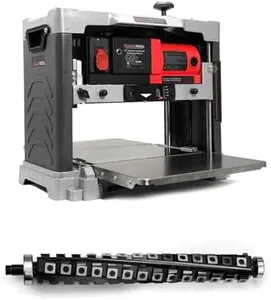
The WEN PL1326 is a solid benchtop planer designed for woodworkers who need to smooth and dimension boards up to 13 inches wide and 6 inches thick. It features a powerful 15-amp motor running at 10,000 RPM, which provides a steady feed rate of 26 feet per minute, helping you work efficiently. One standout feature is its spiral cutterhead with 26 staggered, rotatable high-speed steel blades, which produces a cleaner, smoother finish and quieter operation compared to traditional straight blades.

The planer is built on a cast iron base, offering good stability and durability during use. It includes an onboard material removal gauge for easily monitoring how much wood is removed each pass and has an adjustable dust port to help keep the workspace cleaner. Weighing about 81 pounds, it is heavier than many benchtop models, making it less portable for frequent moves. It operates at a single speed, sufficient for most general tasks but limiting flexibility when adjusting feed rates for different wood types.

Although it does not have advanced dust collection built-in, the dust port allows connecting to a vacuum system, which is beneficial. This planer suits hobbyists and small workshop users seeking smooth finishes on medium-sized boards. Those who require a lighter model or variable speeds might consider other options.

Rating
8.5
Cutting Width
Motor Power
Cutterhead Type

Most important from
710 reviews

Cutting Width
Offers a wider than average 13-inch capacity at a more affordable price point than larger planers.
Motor Power
Delivers impressive performance with quieter operation and easier handling compared to comparable models.
Cutterhead Type
Blades are cost-effective and straightforward to replace or rotate, enhancing long-term value.
Dust Collection
The dust port works effectively when connected to a shop vacuum, though sawdust output is substantial.

Buying Guide for the Best Benchtop Wood Planers

Choosing the right benchtop wood planer can make a significant difference in the quality and efficiency of your woodworking projects. A benchtop wood planer is a tool used to smooth and flatten wood surfaces, ensuring uniform thickness and a polished finish. When selecting a benchtop wood planer, it's important to consider several key specifications to ensure you get the best fit for your needs. Understanding these specs will help you make an informed decision and choose a planer that meets your specific requirements.
Cutting WidthThe cutting width of a benchtop wood planer refers to the maximum width of the wood that the planer can handle. This spec is important because it determines the size of the wood pieces you can work with. Cutting widths typically range from 12 to 15 inches. If you primarily work with smaller pieces of wood, a planer with a 12-inch cutting width may suffice. However, if you often work with larger boards, you might want to consider a planer with a wider cutting capacity to accommodate your projects.
Cutting DepthCutting depth indicates how much material the planer can remove in a single pass. This is crucial for efficiency and achieving the desired thickness quickly. Cutting depths usually range from 1/16 inch to 1/8 inch. For light-duty tasks and finer adjustments, a smaller cutting depth is adequate. For more substantial material removal and faster work, a larger cutting depth is beneficial. Consider the type of projects you undertake and choose a cutting depth that aligns with your needs.
Motor PowerMotor power, measured in amps or horsepower, determines the planer's ability to handle tough materials and maintain consistent performance. Higher motor power means the planer can handle harder woods and larger workloads without bogging down. Motors typically range from 10 to 15 amps. If you work with dense hardwoods or large volumes of wood, a more powerful motor is advisable. For lighter, occasional use, a lower-powered motor may be sufficient.
Cutterhead TypeThe cutterhead is the part of the planer that holds the blades and does the actual cutting. There are two main types: straight knife and helical (or spiral) cutterheads. Straight knife cutterheads are more common and less expensive, but they can be noisier and may leave more noticeable lines on the wood. Helical cutterheads are quieter and provide a smoother finish, but they are more expensive. Choose a cutterhead type based on your budget and the finish quality you desire.
Feed RateFeed rate refers to the speed at which the wood is fed through the planer, usually measured in feet per minute (FPM). A higher feed rate allows for faster material processing, while a lower feed rate can provide a smoother finish. Some planers offer adjustable feed rates, giving you more control over the balance between speed and finish quality. If you need to process large quantities of wood quickly, a higher feed rate is beneficial. For finer, more detailed work, a lower feed rate may be preferable.
Dust CollectionDust collection is an important feature that helps keep your workspace clean and reduces the amount of airborne dust. Planers with built-in dust collection ports can be connected to a shop vacuum or dust collection system. This is especially important if you work in a small or enclosed space. Look for planers with efficient dust collection systems to maintain a cleaner and healthier work environment.
PortabilityPortability refers to how easy it is to move and store the planer. Benchtop planers are generally designed to be more portable than stationary models, but they can still vary in weight and size. If you need to move the planer frequently or have limited workspace, consider a lighter and more compact model. However, if you have a dedicated workspace and prioritize stability, a heavier model may be more suitable.

FAQ