10 Best Table Saw Blades 2026 in the United States

Related Products
Up to 5% off





Our technology thoroughly searches through the online shopping world, reviewing hundreds of sites. We then process and analyze this information, updating in real-time to bring you the latest top-rated products. This way, you always get the best and most current options available.

Our Top Picks
Winner
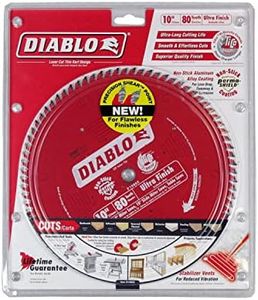
Diablo Ultra Finish Saw Blade for Wood - 10" Diameter, 80 Hi-ATB Teeth, 5/8" Arbor, .098" Kerf, 15� Hook Angle, .071" Plate, 6000 Max RPM - D1080X
The Freud D1080X Diablo 10" 80-tooth ATB Saw Blade is well-suited for those looking for a high-quality blade that delivers ultra-fine finish cuts. With an impressive 10-inch diameter and 80 teeth, this blade is ideal for precise cutting jobs, especially in engineered wood. The ATB (Alternate Top Bevel) tooth configuration enhances cut quality and reduces splintering, making it a great choice for fine woodworking projects.
The carbide material of the blade ensures durability and long-lasting sharpness, which is essential for frequent use. Additionally, the PermaShield coating helps reduce friction and prevent build-up of resin, making the blade easier to maintain and prolonging its lifespan. The laser-cut stabilizer vents are a notable feature as they trap noise and vibration, keeping the blade cool and reducing warping during use.
This can be particularly beneficial for maintaining accuracy and extending the blade's life. The Freud D1080X Diablo blade's ease of use and high performance make it a reliable choice for both amateur and professional woodworkers who need a dependable blade for detailed and smooth cuts.
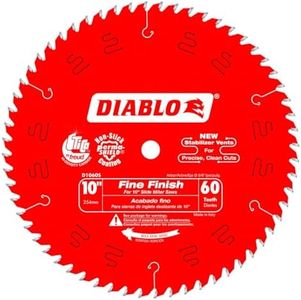
Diablo Fine Finish Saw Blade for Wood - 10" Diameter, 60 ATB Teeth, 5/8" Arbor, .087" Kerf, 7� Hook Angle, .063" Plate, 6000 Max RPM - D1060S
The Diablo Fine Finish Saw Blade is a 10-inch blade designed to deliver smooth, precise cuts, especially on sliding miter saws, jobsite saws, and workshop table saws. Its 60 teeth with an ATB (Alternate Top Bevel) configuration enable cleaner cuts with minimal tear-out, which is ideal if you work a lot with wood types like oak, pine, or plywood, or do fine finish work such as molding. The blade’s 0.087-inch kerf (the width of the cut it makes) is relatively thin, helping reduce material waste and friction, so your saw uses less power and the cuts are faster.
The 7-degree hook angle helps the blade feed through wood smoothly without grabbing or chipping, making it safer and easier to control. Made with high-density TiCo carbide teeth and a hardened steel body, the blade promises durability and a longer sharp edge life. A special non-stick coating protects it from heat build-up and resin build-up, which can dull blades quickly. However, this blade is optimized for fine finish cuts rather than heavy ripping, so it may not be the best choice if you need to cut large pieces of wood quickly.
Its 5/8-inch arbor fits most standard saws, but you should check your saw’s compatibility before buying. This blade is an excellent option for woodworkers and DIYers who prioritize smooth, accurate cuts and want a blade that stays sharp for longer with less maintenance.
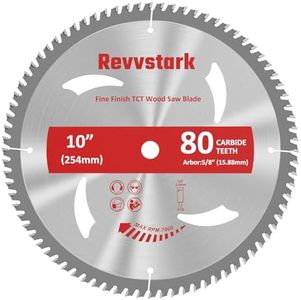
10 Inch Table Saw Blades TCT Circular Saw Blade 80T with 5/8" Arbor, Fine Finish Carbide Miter Saw Blades for Cutting Various Wood Fit Dewalt Craftsman Ryobi
Most important from
1143 reviews
The Revvstark 10 Inch Table Saw Blade, equipped with 80 carbide teeth and a 5/8 inch arbor, is designed for fine finish cuts on various types of wood, making it a versatile tool for both professionals and DIY enthusiasts. The blade's diameter and tooth configuration promise precise and clean cuts, aided by its super thin laser cut kerf which ensures fast and efficient cutting. The use of premium alloy steel and construction-grade tungsten carbide teeth enhances durability and heat resistance, reducing the likelihood of bending and deflection during use.
This makes it suitable for a range of woodworking applications, including softwood, hardwood, and plywood, among others. Additionally, it is compatible with popular brands like Dewalt, Craftsman, and Ryobi. The noise-reducing perforations and thermal expansion grooves are notable features that contribute to a quieter and cooler operation, extending the blade's lifespan. Safety is also a priority, as evidenced by the anti-kickback teeth design that minimizes the risk of injury.
However, the blade might be overkill for simpler projects or those who do not require such a high number of teeth for their tasks. Additionally, its application is limited to wood and some plastics, so it may not be ideal for users needing to cut a broader range of materials. The Revvstark 10 Inch Table Saw Blade is a robust and reliable choice for detailed and high-precision woodworking.